
Education Beyond Boundaries
A Legacy to the Women Who Opened Doors
By Hanan Ayoub
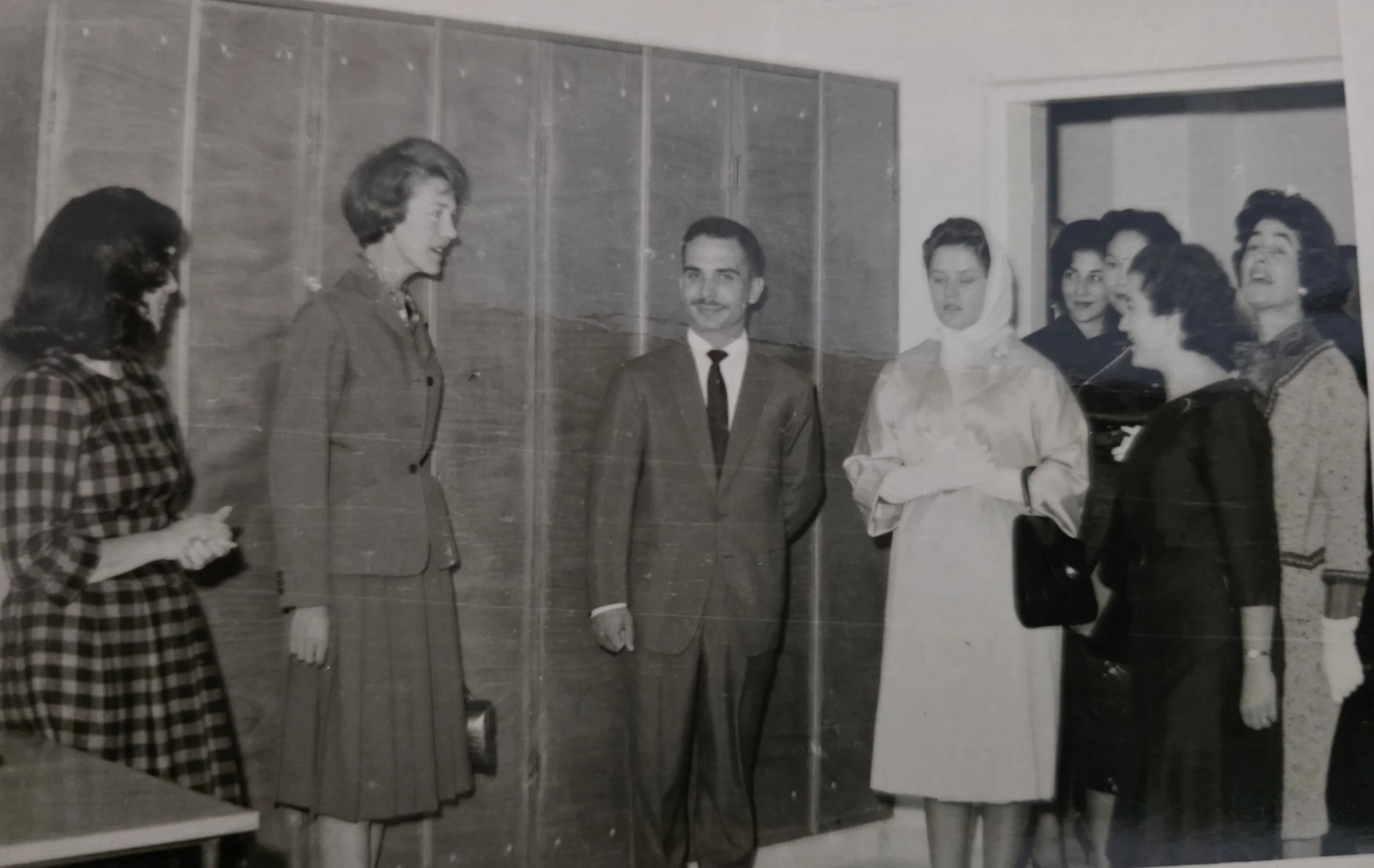
Ramallah Women’s Training Center, known as Al-Tira—an UNRWA college and vocational school created to expand educational opportunities for young Palestine refugee women. Circa 1963.
For generations, the West Jerusalem ancestral village of Lifta was home to families with a deeply rooted Palestinian heritage dating back centuries. My mother and her family enjoyed a beautiful life in Lifta, surrounded by extended family and friends living in a close-knit supportive community. Like many families, their lives were involuntarily uprooted during the Nakba of 1948 where generations of Palestinian were forced to flee the violent sieges of towns and villages. My mother’s family was no exception and fled to Egypt. While they prospered and built strong connections and friendships there, Egypt was not home.
Returning to Lifta would remain an unfulfilled dream for many Palestinians. However, in 1962, my mother Mariam Khalil, and her younger sister, Wajiha, stood at the foundation of an educational institution that would become an integral part of their legacy and a source of lasting pride. As young, unmarried women in their early twenties with bachelor’s degrees in home economics and nutrition from Cairo University, the sky was the limit. They looked to education as a catalyst for women’s empowerment and prospective careers. Both my mother and my aunt became foundational instructors at the newly established Ramallah Women’s Training Center (known as Al-Tira) an UNRWA college and vocational school created to expand educational opportunities for young Palestine refugee women who might not otherwise have had the chance to pursue higher education. Mariam and Wajiha did not simply teach the curriculum of home economics and nutrition. They were instrumental in mentoring women about practical skills, leadership, dignity, and self-reliance.
At a time when geographic conflict and access to four-year university was out of reach for many women, Mariam and Wajiha helped open doors and direct their students to possibilities without boundaries.
Their classrooms were a model of excellence, visited by the late King Hussein of Jordan and other regional dignitaries. Through their acumen and dynamic ability to engage people at all levels, Mariam and Wajiha empowered students with knowledge and expertise they would carry into the next stages of their lives, to their families and communities. My mother would instill in me as she did her students: a woman’s education and financial independence serves as a means for a promising future with personal growth and empowerment. Years later, Al-Tira grew in prominence and expanded with a broad range of majors and courses that enabled young Palestine refugee women to realize that success transcended occupied Palestinian territory.
Inevitably, Mariam and Wajiha would leave behind their positions and professional prestige, as well as the familiarity of the Ramallah community. They would be forced to live in exile due to the difficult circumstances caused by the ongoing occupation. My mother Mariam would immigrate to the United States, raise three children, and establish her own successful business. My Aunt Wajiha would return to Cairo, complete a master’s degree, and elevate her career to the Ministry of Education in Amman, Jordan.
This piece is an excerpt from a memoir and documentation of the historical record of UNRWA’s Al-Tira College. It is a tribute to Mariam and Wajiha Khalil, to their courage, intellect, steadfast resilience and gentle power.
They represent UNRWA’s goal to provide educational pathways for women to enter competitive fields and serve their communities. Mariam and Wajiha’s leadership is a gift of perpetual giving.
They represent a window into a generation of Palestinian women who taught, learned, led, and endured when the environment around them, and perhaps their own personal circumstances, were barriers to achievement. The story of Mariam and Wajiha Khalil belongs to my family’s legacy; it also belongs to the broader history of women’s education, displacement, resilience, and the lasting impact of those who believed that knowledge and education could change the course of a life for the better.
Today, Al-Tira is operated by UNRWA as part of its wider educational system and continues to hold historical prominence in the occupied West Bank, including East Jerusalem. Al-Tira offers technical and vocational science diplomas designed to empower Palestinian women and foster economic independence.
Sustain unrwa’s life-saving work today
If this story touched you and you are able, make a gift to UNRWA USA. And if you can’t give today, share these stories.
